Anycast DNS vs Unicast DNS — Which Is Better for Your Domain?
Compare anycast and unicast DNS routing to understand which approach delivers better performance, resilience, and DDoS protection for your domain.
Answer snapshot
Unicast announces a nameserver IP from one location; anycast announces the same IP from many. With anycast, BGP routes each query to a policy-selected point of presence, so latency is usually lower for distributed users, a failed PoP can be withdrawn from BGP, and volumetric DDoS traffic can be diluted across multiple ingress points. Unicast can be fine for small or single-region domains; managed anycast is usually the better fit for public production DNS that needs resilience.
What you'll learn
- Understand how unicast and anycast routing differ at the BGP level
- Compare performance, resilience, and DDoS protection across both models
- Identify the workloads where unicast is sufficient and where anycast becomes essential
- Recognise the operational trade-offs (cost, complexity, observability) of running anycast
Anycast DNS vs Unicast DNS — Which Is Better for Your Domain?
What You Will Learn
- How unicast and anycast DNS routing work at the network level
- The performance, resilience, and security trade-offs between the two approaches
- When unicast is good enough and when anycast becomes essential
- How DNScale uses anycast across its global edge network
What Is Unicast DNS?
Unicast is the traditional routing model of the Internet. Every IP address maps to exactly one server in one physical location. When a recursive resolver sends a DNS query to a unicast nameserver, that packet always travels to the same machine, regardless of where the resolver sits on the network.
For decades this was how all authoritative DNS worked. You would run two or three nameservers in a data centre, publish their addresses as NS records at the registrar, and every DNS query for your zone would arrive at one of those specific servers.
Unicast in Practice
dig example.com @ns1.provider.com

; ns1.provider.com has a single IP: 203.0.113.10
; Every query from every resolver on the planet
; travels to that one server at that one location.
If ns1.provider.com is in Frankfurt and a resolver in Tokyo queries it, the packet crosses half the planet, accumulating 150-250 ms of round-trip latency before the answer even begins its journey back.
How Unicast Failover Works
With unicast, resilience depends on having multiple nameservers with different IPs. If one goes down, resolvers try the next NS record in the set. But this failover is slow: the resolver must wait for a timeout (typically 2-5 seconds), try another server, and resolvers that already cached the dead server's IP keep retrying it until the TTL expires.
What Is Anycast DNS?
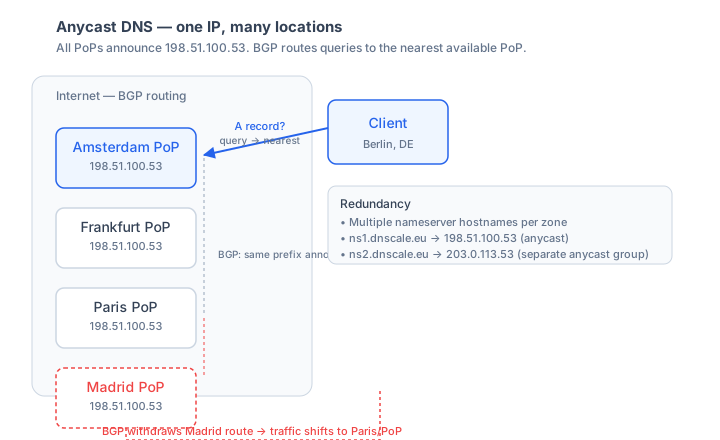
Anycast takes a fundamentally different approach. The same IP address is announced from multiple physical locations simultaneously. When a resolver sends a query to an anycast IP, the Internet's routing fabric delivers that packet to the location selected by BGP policy and topology.
From the resolver's perspective, nothing changes — it queries a single IP address and gets an answer. But behind the scenes, that query was handled by whichever point of presence (POP) won the BGP decision for that resolver's path.
If unicast is like calling a specific phone number that rings one phone on one desk, anycast is like calling a toll-free number where the phone network decides which call centre should answer.
How BGP Makes Anycast Work
Anycast relies on BGP (Border Gateway Protocol), the routing protocol that glues the Internet's autonomous systems together. Here is the sequence:
- Prefix announcement — Each POP announces the same IP prefix (for example, a /24 block) to its upstream transit providers via BGP.
- Route propagation — Those announcements propagate through the global routing table. Every router on the Internet learns that this prefix is reachable through multiple paths.
- Best-path selection — When a packet is destined for an address in that prefix, routers select a BGP best path using local policy, local preference, AS path, MED, origin, and other attributes. Short AS path can matter, but it is not the whole decision.
- Delivery — The packet arrives at whichever POP won the routing decision from that particular point on the Internet.
Because most DNS queries are short, stateless exchanges — a question goes out, an answer comes back — they fit anycast well. There is usually no long-lived connection that must stick to a single server.
Anycast in Practice
dig example.com @ns1.dnscale.eu

; ns1.dnscale.eu resolves to an anycast IP: 185.x.x.1
; A resolver in Europe reaches a nearby European POP.
; A resolver in the US reaches a nearby American POP.
; Same IP, different physical server answering.
You can observe this yourself by running the same dig query from servers in different regions. The answer will be identical, but the response time will differ because each query was answered by a different POP:
# From a server in Europe
dig example.com @185.x.x.1 +stats | grep "Query time"
;; Query time: 2 msec

# From a server in North America
dig example.com @185.x.x.1 +stats | grep "Query time"
;; Query time: 5 msec

# From a server in Asia
dig example.com @185.x.x.1 +stats | grep "Query time"
;; Query time: 8 msec
All three queries hit the same IP, but each was routed to a POP selected by BGP.
Head-to-Head Comparison
The following table summarises the key differences between unicast and anycast DNS across the dimensions that matter most to domain operators.
| Dimension | Unicast DNS | Anycast DNS |
|---|---|---|
| IP mapping | One IP = one server in one location | One IP = many servers in many locations |
| Latency | Depends on distance and routing to the single server; often high for remote users | Usually lower for distributed users; queries route to a selected POP |
| DDoS resilience | Attack traffic concentrates on one location | Attack traffic can be distributed across multiple POPs |
| Failover speed | Resolver must timeout and try next NS; record changes depend on TTL expiry | BGP route withdrawal can shift traffic after convergence |
| Failover mechanism | DNS-layer (resolver retries + TTL wait) | Network-layer (BGP convergence) |
| Geographic coverage | Limited to server locations; remote users suffer high latency | Global coverage with POPs near major exchange points |
| Complexity | Simple — standard server deployment | Requires BGP, AS numbers, IP prefix allocations |
| Cost | Lower — fewer servers, no BGP infrastructure | Higher — multiple POPs, transit agreements, IP space |
| Configuration changes | Failover requires DNS propagation across resolver caches | No DNS changes needed; routing handles everything |
| Best for | Small sites, single-region audiences, simple setups | Global audiences, high availability, DDoS targets |
Performance: Why Latency Matters for DNS
Every website load, API call, and email delivery starts with a DNS lookup. If that lookup takes 200 ms instead of 5 ms, the delay cascades into everything that follows. For sites with dozens of third-party resources, each requiring its own DNS resolution, slow lookups compound into noticeable page load increases.
Unicast Latency Profile
With unicast nameservers in a single region, users near that region enjoy fast lookups while everyone else pays a distance penalty. A European-hosted unicast nameserver might return:
- 5-10 ms for resolvers in Western Europe
- 80-120 ms for resolvers on the US East Coast
- 150-250 ms for resolvers in Asia Pacific
Those numbers represent the round-trip time for a single DNS query. For a domain with short TTLs, resolvers make these trips frequently.
Anycast Latency Profile
Anycast eliminates the distance penalty by placing answering servers near the resolvers. With POPs in Europe, North America, and Asia Pacific, the same domain might return:
- 2-5 ms for resolvers near any POP
- 10-20 ms for resolvers further from a POP but still on the same continent
- 30-50 ms worst case for resolvers in regions without a nearby POP
The difference is not marginal. For latency-sensitive applications, shaving 100-200 ms off DNS resolution directly improves user experience. For A records and AAAA records that point to your primary services, fast resolution is especially important since those lookups sit on the critical path of every connection.
DDoS Protection: Absorbing Attacks at Scale
DNS is one of the most attacked layers of the Internet. A DDoS attack targeting your nameservers can take your entire online presence offline — not just your website, but email, APIs, and every service that depends on DNS resolution.
Unicast Under Attack
With unicast, all attack traffic converges on a small number of servers. A 10 Gbps flood aimed at a unicast nameserver must be absorbed by that single location's network capacity. If the attack exceeds the server's or data centre's capacity, your DNS goes down and your domain becomes unreachable.
Anycast Under Attack
With anycast, the same 10 Gbps attack can land across multiple POPs announcing the target prefix. The split depends on attacker locations and BGP policy, not simple division by POP count. Each POP can apply local rate limiting and scrubbing while continuing to serve legitimate queries where capacity remains healthy.
This is not a theoretical benefit. Anycast-based DNS is widely used for DDoS resilience because it can turn a concentrated attack into a distributed, diluted one. More POPs help only when they have useful routing, capacity, and filtering.
DNS DDoS attacks affect everything tied to your domain. Unlike a web server attack that takes down one site, a DNS attack can render your domain unresolvable — no website, no email, no API. Anycast is one of the most important architectural defences against this class of threat when paired with filtering and capacity. Learn more in our DNS Attacks and Threats guide.
Failover: Seconds vs Minutes
How quickly your DNS recovers from a server failure directly determines your downtime.
Unicast Failover
When a unicast nameserver goes offline, recovery depends on the DNS layer:
- A resolver sends a query to the failed server's IP.
- The query times out after 2-5 seconds.
- The resolver tries the next NS record (if one exists).
- If the resolver had cached the failed server as its preferred NS, it continues retrying until the cached entry expires based on the NS record's TTL.
- Other resolvers that cached answers from the failed server continue serving stale data until the record TTL expires.
Total recovery time: seconds to minutes for the resolver to switch NS records, plus up to the full TTL duration for cached answers to expire across the Internet. With typical TTL values, this can mean 5-60 minutes of degraded resolution.
Anycast Failover
When an anycast POP goes offline, recovery happens at the network layer:
- The POP withdraws its BGP route for the anycast prefix.
- Upstream routers converge on the remaining routes, often within seconds to tens of seconds.
- Traffic that was flowing to the failed POP shifts to another healthy POP after convergence.
- No DNS changes are needed. No TTL expiry is required. No resolver behaviour changes.
Total recovery time depends on BGP convergence and upstream routing policy. From the resolver's perspective, the IP address never changed — it just started reaching a different physical server after routing reconverged.
This difference is significant. With anycast, a POP failure is a routing event, not a DNS event. Resolvers, clients, and zone delegations remain unchanged.
When Unicast Makes Sense
Unicast is not inherently bad. For certain use cases, it is perfectly adequate:
- Small sites with a regional audience — If your users are concentrated in one city or country and your nameservers are nearby, the latency penalty is negligible.
- Simple infrastructure — Unicast does not require BGP knowledge, AS numbers, or IP prefix allocations. Two servers with static IPs and standard NS delegation work fine.
- Internal or private DNS — Corporate DNS for internal services does not need global distribution. A pair of unicast servers behind a load balancer is standard practice.
- Budget constraints — Running a global anycast network requires significant infrastructure investment. For a personal blog or small business site, the cost is hard to justify when managed unicast DNS is available for a few dollars per month.
- Testing and development — Development environments rarely need production-grade DNS resilience.
If you are running a personal project, a small business website, or a service with a single-region user base, unicast DNS from a reputable provider is a reasonable choice. The key is understanding when you have outgrown it.
When Anycast Matters Most
As your requirements grow, anycast becomes increasingly valuable:
- Global audience — If your users span multiple continents, unicast can create a latency disadvantage for users far from the server's region. Anycast reduces this by answering from routed POPs closer to major resolver networks.
- High availability requirements — If DNS downtime means lost revenue, SLA breaches, or user-facing outages, BGP-level withdrawal can recover faster than DNS-layer record changes when routing converges cleanly.
- DDoS exposure — Any domain that is a potential DDoS target — e-commerce, SaaS platforms, financial services, gaming — benefits from anycast's traffic dilution. A single-location DNS setup concentrates volumetric attacks in one place.
- Multi-provider DNS strategies — When running multi-provider DNS for redundancy, anycast providers offer better baseline performance for each provider in the set.
- Secondary DNS architectures — Anycast ensures your secondary nameservers are reachable with low latency globally, not just from the region where the secondary server is physically located.
- Regional serving requirements — Some organizations want authoritative DNS to be served from specific regions. Anycast with regional scoping (like separate EU and Global networks) can support that serving model, though internet routing still needs to be assessed separately for strict jurisdictional requirements.
How DNScale Implements Anycast
DNScale runs a purpose-built anycast DNS network designed for low latency, routing-level failover, and regional serving options.
Global Network
DNScale operates points of presence across Europe, North America, and Asia, each located near major Internet Exchange Points (IXPs) to keep DNS answers close to the resolvers that serve end users.
The network is split into two tiers so customers can choose per-zone whether DNS should be answered from EU-only infrastructure or from the full global footprint, simply by selecting the appropriate nameservers during delegation at the registrar.
The Stack at Each POP
Every POP runs the same layered stack:
- BGP routing engine — Announces anycast prefixes to upstream transit providers and withdraws routes automatically if local health checks fail.
- DNS query router — Accepts queries on the anycast IPs, performs health checking, caches responses, and balances load across backend nameservers.
- Authoritative DNS engine — Serves the actual DNS records from a locally replicated database.
Zone data is synchronised across POPs using database replication so each healthy POP can return the same intended answers. When you update an A record, a CNAME, or any other record type through the dashboard or API, deployment to the edge is designed to complete quickly, while resolver-visible changes still depend on TTL and caching.
For a deeper look at how DNScale's routing intelligence works beyond basic anycast, including ingress sensing, policy engine, and route signalling, read the Global DNS Resolution Balancing guide.
Verifying Anycast Behaviour with dig
You can confirm that anycast is working by querying the same nameserver IP from different network locations and comparing response times.
# Query from a European vantage point
dig example.com @ns1.dnscale.eu +stats
;; Query time: 3 msec
;; SERVER: 185.x.x.1#53(185.x.x.1)

# Query from a North American vantage point
dig example.com @ns1.dnscale.eu +stats
;; Query time: 4 msec
;; SERVER: 185.x.x.1#53(185.x.x.1)

# Query from an Asia Pacific vantage point
dig example.com @ns1.dnscale.eu +stats
;; Query time: 7 msec
;; SERVER: 185.x.x.1#53(185.x.x.1)
Notice that the server IP is identical in all three responses. With unicast, distant regions often see much higher response times. With anycast, response times are usually lower because each query can be answered by a routed POP near or well-peered with that resolver.
You can also use the +nsid option (if supported by the provider) to see which POP actually answered your query:
dig example.com @ns1.dnscale.eu +nsid
;; OPT PSEUDOSECTION:
; NSID: 61 6d 73 ("ams")
Key Takeaways
- Unicast DNS maps each IP to one server. It is simple and affordable but creates latency for distant users and relies on slow DNS-layer failover.
- Anycast DNS maps one IP to many servers across multiple locations. BGP routing delivers each query to a selected POP, usually improving latency and giving routing-level failover and DDoS dilution.
- Anycast failover happens at the network layer after BGP convergence. Unicast failover depends on resolver timeouts and, for record changes, TTL expiry, which can take minutes or longer.
- For small, single-region sites, unicast can be fine. For global audiences, high-availability requirements, or DDoS exposure, managed anycast is usually the better choice.
- DNScale's anycast network spans multiple POPs across two autonomous systems, giving customers both global reach and EU-scoped authoritative serving options.
Further Reading
- What is an Anycast DNS Network? — How anycast networking and BGP routing work in detail
- Global DNS Resolution Balancing — DNScale's GDRB pipeline for intelligent query steering
- What is DNS? — Fundamentals of the Domain Name System
- DNS Record Types — Overview of all DNS record types
- DNS Server Types — Authoritative vs recursive servers explained
- DNS Attacks and Threats — How DDoS and other attacks target DNS
- Multi-Provider DNS Deployment — Redundancy across multiple DNS providers
- DNS Propagation Explained — Why DNS changes take time and how caching works
- DNS TTL Best Practices — Choosing the right TTL for your records
- What is Secondary DNS? — Primary and secondary nameserver redundancy
- DNS Delegation by Region — Setting up nameserver delegation for DNScale regions
Frequently asked questions
- Is anycast always better than unicast for DNS?
- For domains that serve users globally or where DNS downtime has commercial cost, usually yes. Anycast can reduce mean query latency, withdraw failed PoPs from BGP, and dilute some DDoS attacks across multiple ingress points. Unicast is acceptable for low-volume internal domains, lab environments, or single-region services where extra latency and provider redundancy are not material.
- Can I get anycast without running my own AS number?
- Yes — and most companies do. Managed DNS providers like DNScale, Cloudflare, and Route 53 give you anycast by default just by delegating your nameservers to them. Running your own anycast network requires an AS number, IP space, BGP peering at IXPs, and 24/7 network operations — which is rarely cost-effective unless DNS is core to your business.
- Does anycast improve DNSSEC validation performance?
- Indirectly. DNSSEC adds one or two extra queries (DNSKEY, DS) to the resolution path. Anycast does not change the protocol, but it lowers the per-query round-trip time, so the cumulative latency cost of validation drops. The bigger win is that anycast PoPs are reachable even when individual sites fail — important when DNSSEC validation requires a complete chain.
- What happens if a BGP route flaps in an anycast deployment?
- A route flap can remove a PoP from the routing table briefly; resolvers affected by that path re-converge on another PoP after BGP updates propagate. DNS retries and recursive caches often hide short events, but some users can see timeouts during convergence. Operators should see it in routing and DNS monitoring.
- Can I mix anycast and unicast nameservers for the same zone?
- Yes. You can delegate a zone to both anycast and unicast authoritative nameservers, for example DNScale anycast nameservers plus a self-hosted secondary. This only works safely if all nameservers serve the same zone data, have matching SOA and NS records, and are monitored. Recursive resolvers usually prefer nameservers with better observed latency and retry others on failure, so the anycast provider will likely receive most traffic, but the unicast server is not purely passive and must be sized and operated as a real authoritative nameserver. DNSSEC requires extra care: either serve identical signed data or use a correct multi-signer DNSSEC setup.
Related guides
Performance
What is an Anycast DNS Network?
Learn how anycast networking works, why it matters for DNS, and how it delivers low-latency, resilient name resolution worldwide.
Performance
What is Anycast DNS? A Plain-Language Guide
Anycast DNS explained from the ground up — what it is, why it matters, and how BGP routing makes one IP reachable from many places.
Performance
Round-Robin DNS Explained
How round-robin DNS works, when multiple A or AAAA records are useful, and why round-robin is not the same as health-checked DNS failover.
Performance
DNS Network Performance Monitoring
How DNScale measures real-time DNS response times from independent RIPE Atlas probes across backbone and last-mile networks worldwide.
Ready to manage your DNS with confidence?
DNScale provides anycast DNS hosting with a global network, real-time analytics, and an easy-to-use API.
Start free