What is Anycast DNS? A Plain-Language Guide
Anycast DNS explained from the ground up — what it is, why it matters, and how BGP routing makes one IP reachable from many places.
Answer snapshot
Anycast lets many physical servers share the same IP address. The internet's routing fabric (BGP) sends each query to a route selected by network policy, often a nearby or well-peered server. For DNS this usually means lower latency for distributed users, routing-level failover when a server withdraws its route, and DDoS dilution because attack traffic can land at multiple ingress points instead of one.
What you'll learn
- Define anycast in plain language and contrast it with unicast
- Understand at a high level how BGP makes anycast routing work
- Identify the three main benefits of anycast for DNS (latency, failover, DDoS dilution)
- Recognise when anycast matters and when it doesn't
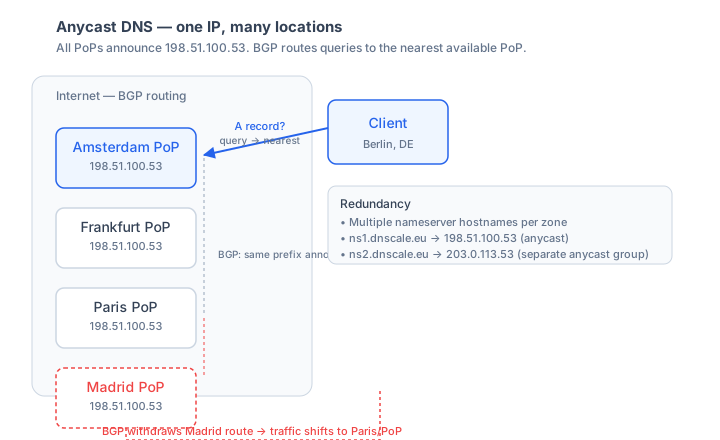
If you've used a large managed DNS provider in the last decade, you've probably used anycast — even if nobody told you. It's the technology that makes "the same IP address" reachable from different physical servers in different parts of the world, and it's one reason DNS queries can be answered quickly from many regions.
This guide is the plain-language introduction. For the deeper architectural picture — how DNScale specifically implements anycast, including the dual-AS EU/Global model — see What is an Anycast DNS Network?. For the comparison with unicast, see Anycast DNS vs Unicast DNS.
Anycast in One Sentence
Anycast lets many servers share a single IP address, and the internet sends each request to the route selected by BGP policy and topology.
That's it. Everything else is mechanics.
The Mental Model
In the traditional, "unicast" model:
1.2.3.4 ────────────── one specific server in one specific placeEvery request to 1.2.3.4 goes to that one server. If you're in Tokyo and the server is in New York, your packets travel half the world. If the server fails, every request fails until you bring it back up or change DNS to point elsewhere.
In anycast:
1.2.3.4  ──────────────  server in Frankfurt
1.2.3.4  ──────────────  server in Singapore
1.2.3.4  ──────────────  server in São Paulo
1.2.3.4  ──────────────  server in San Francisco
1.2.3.4  ──────────────  ... and 20 more locations
All of these servers announce the same IP address into the internet's routing system. When you make a request, your packets are routed to whichever server wins the BGP decision from your part of the internet. That is often topologically nearby, but routing policy and peering matter. None of this requires you to know where the server is, or for the server to know where you are.
The "magic" is that this isn't really magic. It's just BGP doing what it does.
How BGP Makes It Work
BGP — Border Gateway Protocol — is how networks tell each other "I have a route to these IP addresses." Every Autonomous System (AS) on the internet runs BGP and exchanges routing information with its neighbours.
When a DNS provider runs anycast:
- They allocate an IP block (say,
203.0.113.0/24) to their nameservers. - From each PoP, their BGP-speaking router announces "I have a route to
203.0.113.0/24" to its peers. - Those peers propagate the announcement to their peers, and so on across the internet.
- Now every router on the internet knows multiple paths to
203.0.113.0/24— one through each PoP. - Each router picks a BGP best path using policy, local preference, AS path, MED, origin, and other attributes.
Result: traffic from each part of the internet ends up routed to the PoP preferred by BGP policy and topology. No central traffic director, no application-layer logic, no client-side configuration. It's all happening at the routing fabric.
For a DNS query specifically:
[ Client in Tokyo ]
    │ asks "what's the A record for example.com?"
    ▼
[ Local recursive resolver ]
    │ needs to query the authoritative nameserver at 203.0.113.5
    ▼
[ Tokyo ISP's BGP routes the query toward 203.0.113.5 ]
    │ which means the DNScale PoP BGP selects
    ▼
[ DNScale Singapore PoP ] ← selected by BGP from this route
    │ answers the query
    ▼
[ Client in Tokyo gets the answer in ~30ms ]
A client in Berlin doing the same query reaches the Frankfurt PoP. Same IP, different physical destination. Both get the same answer (because every DNScale PoP serves the same authoritative zone data), but the latency is shaped by physical proximity.
The Three Big Benefits
1. Lower latency
DNS queries are tiny and round-trip-time-sensitive. Every web page load typically involves multiple DNS lookups; if each takes 200ms instead of 20ms, users feel it. Anycast can reduce the resolver-to-authoritative round-trip by letting BGP route the resolver toward a nearby or topologically preferred authoritative site.
Concrete numbers from a typical setup:
- Within a metro (e.g., Frankfurt to Frankfurt): 1–10ms
- Within a continent (e.g., Berlin to Frankfurt or to Amsterdam): 10–30ms
- Cross-continent (e.g., Tokyo to Singapore): 30–80ms
- Worst case across the world (anycast routes a Tokyo client to a far PoP because nearer PoPs are unreachable): 200ms+
Compare to unicast at e.g. New York: every non-North American client pays 100ms+ minimum just for the round-trip.
2. Automatic failover
When an anycast PoP fails — server crash, datacentre outage, network partition — the BGP advertisement from that PoP is withdrawn (either by the local routers' health checks or by the PoP becoming unreachable). The internet's routing fabric reconverges, often within seconds to tens of seconds, and traffic that was hitting the failed PoP moves to another available route.
There's no DNS change. No traffic re-steering. No central decision. The failure is absorbed at the routing layer.
For comparison: in unicast, a server failure means every client trying to reach that IP fails until you either bring the server back up or update DNS to point at a different IP — a process that can take minutes to hours of cache TTL aging out.
3. DDoS dilution
A DDoS attack against an anycast IP is less likely to concentrate at one location. Attack traffic from different parts of the internet is routed by the same BGP rules, so it can land at several POPs instead of a single ingress.
The split is not simple division by POP count: attacker location, route policy, peering, and capacity determine where traffic lands. Still, this is one of the structural reasons anycast became common for high-availability DNS — it makes many volumetric DDoS attacks harder to concentrate.
(Application-layer attacks, like NXDOMAIN floods or water-torture attacks, still need additional defences. Anycast handles volume; it doesn't auto-handle every attack pattern.)
When Anycast Matters
Almost always, for any DNS that serves real users. Specifically:
- Public-facing websites and APIs — every page load involves DNS, and latency adds up.
- Email — MX lookups happen on every inbound message; receiving servers are often far from your domain's authoritative server.
- Mobile applications — mobile networks have variable resolver paths; anycast minimises the variance.
- Multi-region SaaS — your customers are global; your DNS should be too.
When does anycast not matter?
- Internal-only DNS — corporate
corp.example.comzones served only inside a private network. Use a single DNS server or simple primary/secondary inside the network; anycast is overkill. - Single-region services — if all your users are in one metro and you have a single nearby DNS PoP, anycast adds little.
- Test / staging zones — if downtime is acceptable, anycast's resilience benefit is wasted.
In practice, even single-region services usually benefit from a managed anycast provider because the operational cost is the same — and the multi-region resilience comes free.
What "Anycast" Doesn't Mean
A few common misconceptions:
- Anycast is not magic load balancing for stateful services. It works well for short DNS exchanges. For stateful TCP / HTTPS, the same client must reliably reach the same server through the connection lifetime — which usually does happen but isn't guaranteed by BGP. CDNs use anycast for the front door but other techniques (consistent hashing, stateful PoP affinity) for the connection state.
- Anycast is not faster than the speed of light. It minimises the routing path, but if all your PoPs are in Europe and your client is in São Paulo, the answer still has to cross the Atlantic.
- Anycast is not a substitute for DNSSEC. Anycast is a delivery mechanism; DNSSEC is data authentication. Both layers are independently valuable. See What is DNSSEC?.
- Anycast is not the same as "global anycast." Some providers run regional anycast (e.g., EU-only for sovereignty reasons); some run global anycast everywhere. The distinction matters for jurisdiction-conscious deployments. DNScale runs both — see DNS delegation for DNScale regions.
Anycast vs Other Distribution Strategies
| Strategy | How it distributes | Pros | Cons |
|---|---|---|---|
| Unicast | One IP, one server | Simple, easy to reason about | No redundancy, no latency optimisation, single point of failure |
| DNS round-robin | Multiple A records, resolver picks | Easy, no special infrastructure | No health-check, slow failover (TTL-bound), uneven distribution |
| GeoDNS | DNS provider returns different IPs based on client geography | Coarse geo-routing | Adds DNS-layer logic; granularity limited to GeoIP databases |
| Anycast | One IP, BGP routes to selected PoP | Low latency, routing-level failover, DDoS dilution | Requires BGP expertise, IP space, AS number; or managed provider |
For public authoritative DNS, anycast is widely used because it solves latency and availability problems at the routing layer instead of relying on clients to choose distant nameservers well.
Where DNScale Sits
DNScale runs anycast as the default for every zone — there's no "anycast plan." Specifically:
- Two anycast networks — an EU-only anycast for jurisdictionally-isolated DNS, and a Global anycast for worldwide low latency. Customers choose per zone.
- Direct BGP control — DNScale operates under its own AS numbers, not as a tenant in a larger provider's AS. This means we can withdraw a PoP from BGP within seconds during incident response, without coordinating through an upstream.
- Public footprint — AS numbers, IXP peering, PoP locations are all published. See DNScale infrastructure and EU operations.
This isn't unique to DNScale — many managed DNS providers run some form of anycast. The differences between providers are about footprint, routing control, jurisdictional options, peering depth, IaC parity, and pricing.
Related Reading
- What is an Anycast DNS Network? — deeper architectural explanation
- Anycast DNS vs Unicast DNS — direct comparison
- Global DNS Resolution Balancing — how DNScale implements anycast routing
- GeoDNS and traffic steering — when DNS changes the returned endpoint
- Latency-based DNS routing — measurement-driven answer selection
- DNS server types — authoritative vs recursive context
- DNS delegation for DNScale regions — choosing the right anycast network
- DNScale infrastructure and EU operations
- Multi-provider DNS deployment
References
- IETF RFC 4786 — Operation of Anycast Services
- IETF RFC 1546 — Host Anycasting Service (historical foundation)
- IETF RFC 7094 — Architectural Considerations of IP Anycast
- BGP routing references: RFC 4271 (BGP-4)
- RIPE / ARIN: AS number and IP allocation policies
Frequently asked questions
- Is anycast different from a CDN?
- Anycast is a network-layer technique (IP addresses); CDNs are a content-distribution architecture that often uses anycast underneath. A CDN like Cloudflare or Akamai runs anycast for both DNS and content delivery. For DNS specifically, anycast is the standard mechanism for distributing authoritative servers across the globe — you don't need a 'CDN for DNS', you just need anycast DNS.
- Do I need anycast DNS for my small website?
- Probably, if the site is public and uptime or global latency matters — but you may already have it without thinking about it. Many managed DNS providers run anycast by default, so you get it as a side effect of choosing managed DNS. The exception is self-hosting DNS on one or two unicast VPSs; for production traffic, managed anycast is usually more resilient.
- How is anycast different from a load balancer?
- A load balancer is a single IP that distributes traffic across backend servers behind it — the load balancer itself is a single point. Anycast distributes the IP itself across many physical locations using BGP. With anycast, there's no central balancer; the routing fabric of the internet decides which server each client reaches. For DNS specifically, short stateless queries fit anycast well; for stateful TCP services it's more complex.
- What happens when an anycast server fails?
- BGP, the routing protocol of the internet, reconverges after the failed server's advertisement is withdrawn. The routing fabric picks another available route announcing the same IP. Convergence often takes seconds to tens of seconds; DNS retries and caches may hide it, but short timeouts are still possible. This is one of anycast's headline benefits: failover is infrastructure-driven, not based on changing DNS records.
- Can I run my own anycast?
- Yes, but it's substantial work. You need an Autonomous System (AS) number from a regional internet registry (RIPE in Europe, ARIN in North America), your own IP space, BGP-speaking routers in multiple locations, peering or transit agreements at internet exchanges, and 24/7 network operations. Most companies skip this entirely and use a managed DNS provider that already runs anycast — at a fraction of the cost and operational complexity.
- What does 'anycast PoP' mean?
- PoP stands for Point of Presence — a physical site where a provider has servers connected to one or more networks. An anycast network has many PoPs, each announcing the same IP address(es). When a client queries an anycast IP, BGP routes the query to the selected PoP based on routing policy and topology.
Related guides
Performance
What is an Anycast DNS Network?
Learn how anycast networking works, why it matters for DNS, and how it delivers low-latency, resilient name resolution worldwide.
Performance
Anycast DNS vs Unicast DNS — Which Is Better for Your Domain?
Compare anycast and unicast DNS routing to understand which approach delivers better performance, resilience, and DDoS protection for your domain.
Performance
Round-Robin DNS Explained
How round-robin DNS works, when multiple A or AAAA records are useful, and why round-robin is not the same as health-checked DNS failover.
Performance
DNS Network Performance Monitoring
How DNScale measures real-time DNS response times from independent RIPE Atlas probes across backbone and last-mile networks worldwide.
Ready to manage your DNS with confidence?
DNScale provides anycast DNS hosting with a global network, real-time analytics, and an easy-to-use API.
Start free